
Plunge Pools in Utah: Are They Worth It?
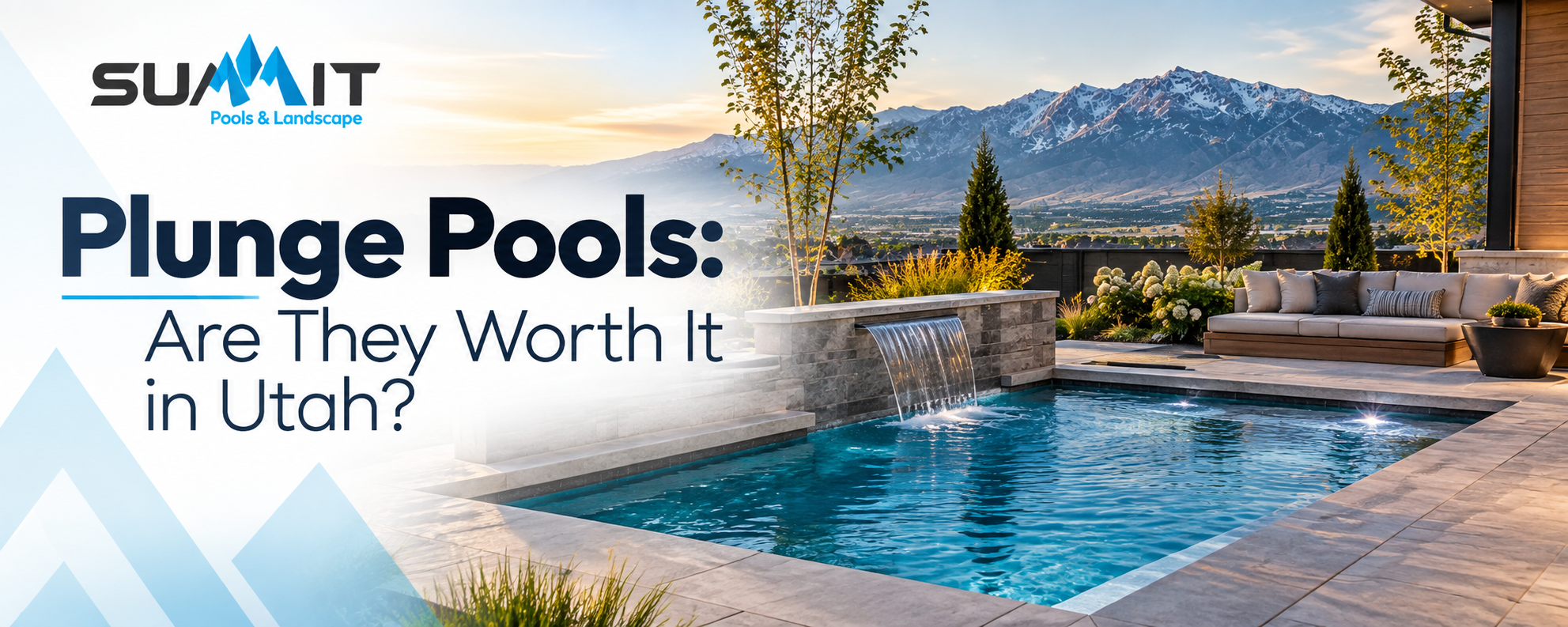
There is a point in almost every pool-planning conversation when homeowners look at their backyard and ask:
Do we really need a full-size swimming pool?
Maybe you want somewhere to cool off during Utah's hot summers, but you don't need a deep end. Maybe you'd rather preserve more of the backyard for landscaping, a patio, fire pit, or outdoor kitchen. Or maybe you love the idea of a heated pool where you can sit, relax, and unwind without dedicating most of the yard to water.
That's where a plunge pool starts to make a lot of sense.
Plunge pools are smaller than traditional swimming pools and are designed primarily for relaxing, cooling off, socializing, and—in some designs—hydrotherapy. Their compact footprint makes them particularly appealing for smaller backyards and homeowners who want a pool without having the pool dominate the entire outdoor space. Summit already offers plunge pools as part of its custom pool options. Summit Pools Utah
But are they actually worth building in Utah?
For the right homeowner, they absolutely can be. Here's what you should consider.
What Is a Plunge Pool?
A plunge pool is essentially a compact swimming pool designed more for relaxation than swimming laps.
There isn't one required size or shape. A plunge pool might be a small rectangle tucked beside a patio, a modern square pool with built-in benches, or a spa-inspired pool with jets and heating.
What separates it from a traditional swimming pool is primarily how the space is used.
Instead of designing around diving, laps, or large groups of swimmers, plunge pools are often designed around features like built-in seating, steps, hydrotherapy jets, heating, LED lighting, water features, and shallow lounging areas.
That opens up some interesting possibilities for Utah backyards.
Utah is an interesting place to own a pool because we get both extremes.
Summers can be hot, sunny, and dry, while Northern Utah winters bring freezing temperatures, snow, and freeze-thaw cycles. Pool design and winterization therefore matter here in ways they may not in consistently warm climates. Summit Pools Utah
A plunge pool can work particularly well with those conditions.
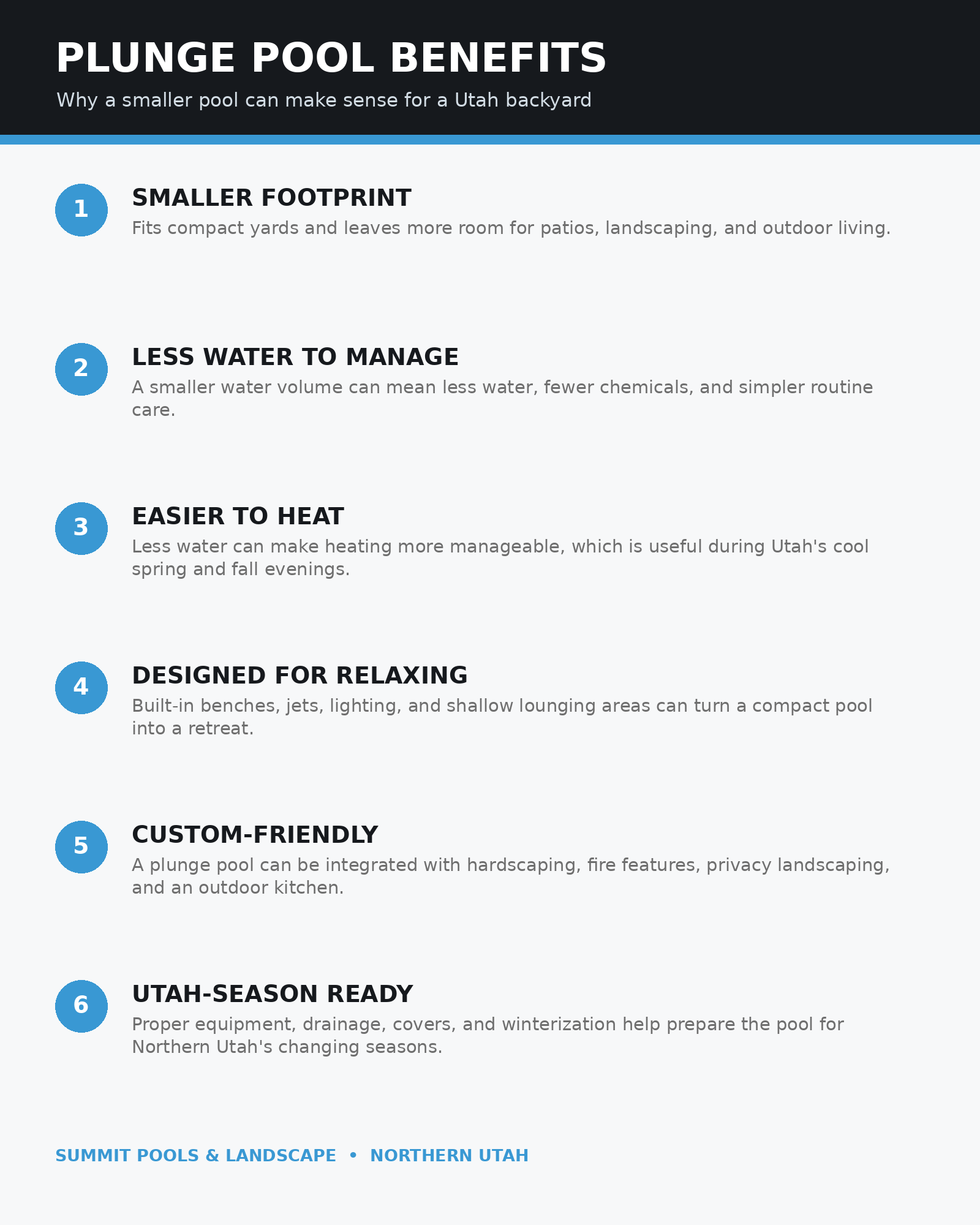
1. You Get the Pool Experience Without Giving Up the Entire Backyard
This may be the biggest advantage.
Not every Utah home has an enormous backyard—and even when it does, homeowners may not want the entire yard devoted to a swimming pool.
A smaller plunge pool can leave room for:
Outdoor kitchen
Fire pit or fireplace
Lawn or artificial turf
Garden beds
Play areas
Lounge seating
Hot tub or integrated spa
Instead of designing the yard around the pool, you can design the pool as one component of a complete outdoor living space.
That's especially useful on smaller or narrower lots.
2. They're Great for Cooling Off During Utah Summers
Sometimes you don't need a 30-foot pool.
You just want to get in the water.
A plunge pool gives you somewhere to cool down after working in the yard, relax on a hot afternoon, or spend an evening outside with family and friends.
For homeowners who primarily envision themselves lounging rather than swimming laps, a large pool may provide a lot of water they rarely use.
3. A Smaller Pool Can Be Easier to Heat
This is one of the features that makes plunge pools particularly interesting in Utah.
A smaller body of water generally requires less energy to bring to a desired temperature than a much larger pool under otherwise similar conditions.
Add a quality pool cover, and you can also reduce heat loss and evaporation. Summit's pool-maintenance guidance notes that covers can help reduce both evaporation and heat loss—two useful considerations in Northern Utah's dry climate and cooler nights. Summit Pools Utah
That means a heated plunge pool can become much more than a July-and-August backyard feature.
4. You Can Make It Feel More Like a Spa
This is where plunge pools become really interesting.
Because you're not trying to maximize swimming space, the design can focus more heavily on comfort.
Imagine a heated plunge pool with a wide underwater bench, therapy jets, LED lighting and a sheer-descent waterfall.
Add a fire feature beside it, privacy landscaping and a covered patio, and the backyard starts feeling more like a private resort than a traditional swimming pool.
5. There's Less Water to Maintain
A smaller pool contains less water, which can translate into less water and fewer chemicals to manage than a much larger pool. Summit's existing plunge-pool guidance similarly notes the advantages of reduced water, chemical and energy requirements compared with larger pools. Summit Pools Utah
That doesn't make a plunge pool maintenance-free.
You'll still need proper water chemistry, filtration, circulation, cleaning and seasonal care. And in Northern Utah, proper winterization remains important because freezing temperatures can damage vulnerable plumbing and equipment. Summit Pools Utah
But you're doing all of that on a smaller scale.
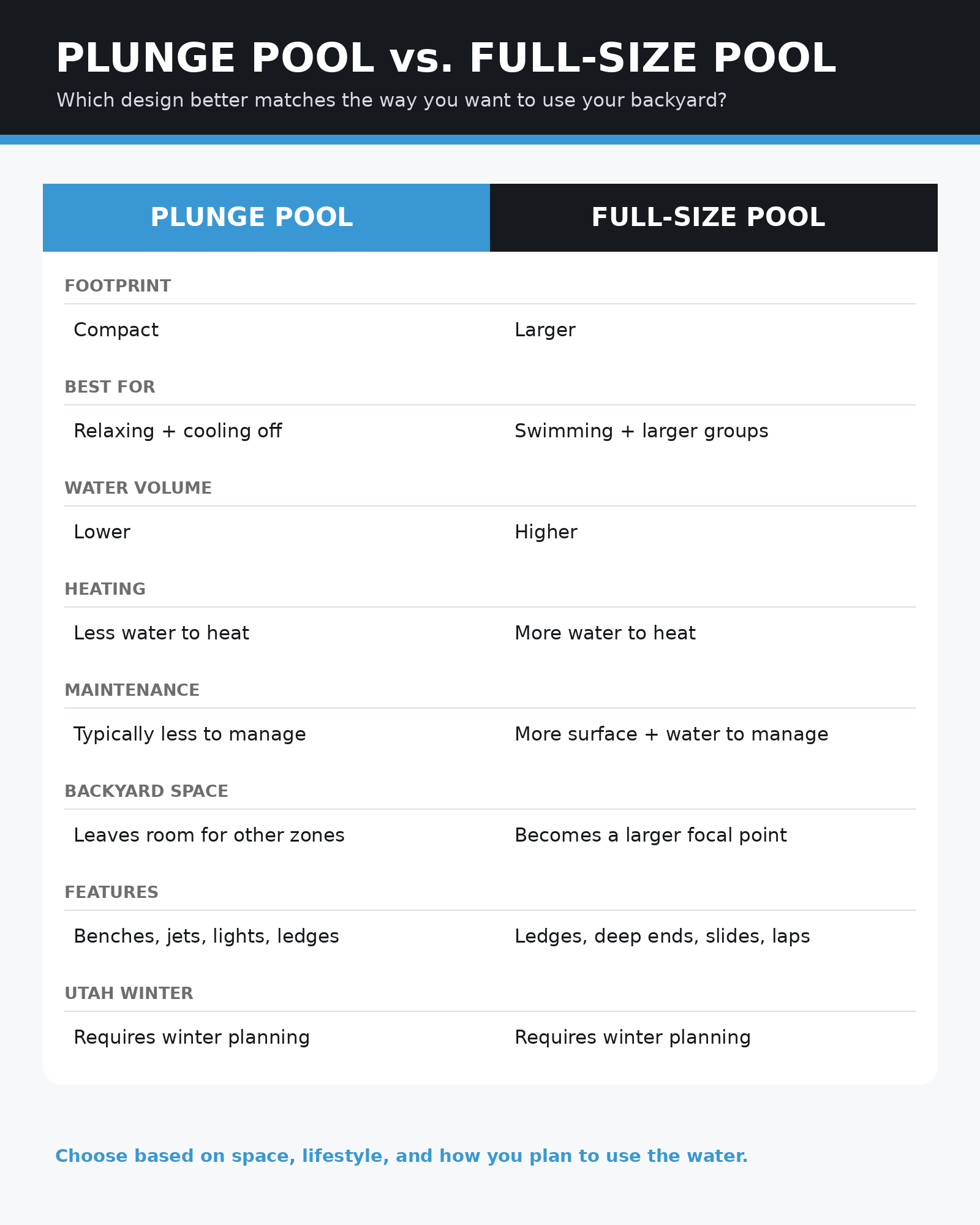
Plunge Pool vs. Traditional Pool
Neither option is automatically better.
The important question is how your family actually wants to use the backyard.
A traditional pool makes more sense if swimming, larger gatherings, deeper water, pool games or having a substantial swimming area are priorities.
A plunge pool becomes much more compelling if your priorities are relaxation, cooling off, a smaller footprint, preserving outdoor-living space and potentially extending your use with heating.
Can You Use a Plunge Pool Year-Round in Utah?
Potentially—but the pool needs to be designed for how you intend to use it.
Some homeowners may want a traditional seasonal plunge pool that is winterized along with other pool equipment.
Others may want something closer to a pool-and-spa hybrid that can be heated during colder weather.
If extended-season use is important to you, that conversation should happen before construction, because heating, plumbing, equipment, covers and winter operation all need to be considered as part of the design.
Utah's freezing temperatures make winter preparation particularly important for pools, plumbing, equipment and water features. Summit Pools Utah
What Features Should You Add to a Plunge Pool?
This is where a custom plunge pool can become much more than a small rectangle of water.
For Utah homeowners, we'd consider features such as built-in bench seating, hydrotherapy jets, an automatic cover, pool heating, LED lighting, a tanning ledge or oversized entry step, a sheer-descent waterfall, fire features, smart pool automation and surrounding privacy landscaping.
You don't need all of them.
In fact, one of the advantages of a smaller pool is that a few thoughtfully chosen details can have a significant visual impact.
A simple rectangular plunge pool with beautiful coping, a built-in bench, warm lighting and one water feature can look incredibly high-end.
Does a Plunge Pool Cost Less Than a Traditional Pool?
Often, but smaller doesn't automatically mean inexpensive.
A plunge pool requires many of the same fundamental components as a larger in-ground pool: excavation, structural work, plumbing, electrical work, filtration, equipment, decking, permits and site preparation.
The final investment depends heavily on the construction method, site conditions and features you select. Summit's current Utah pool-cost guide notes that features such as heaters, automatic covers, lighting, decking and landscaping can meaningfully affect the overall project budget. Summit Pools Utah
So rather than thinking:
“How cheap can we make a small pool?”
A better question is:
“How much of the backyard experience we want can we create in a smaller footprint?”
That's where plunge pools can provide tremendous value.
What Are the Downsides of a Plunge Pool?
There are tradeoffs.
If your dream involves kids doing cannonballs, teenagers bringing over a group of friends, swimming laps, volleyball games or a true deep end, a plunge pool probably isn't going to deliver that experience.
Summit's own plunge-pool guidance points out that these pools are better suited to relaxation and smaller spaces than lap swimming or hosting large groups. Summit Pools Utah
That's why we wouldn't choose one simply because it fits.
We'd choose one because its purpose fits the way you'll actually use your backyard.
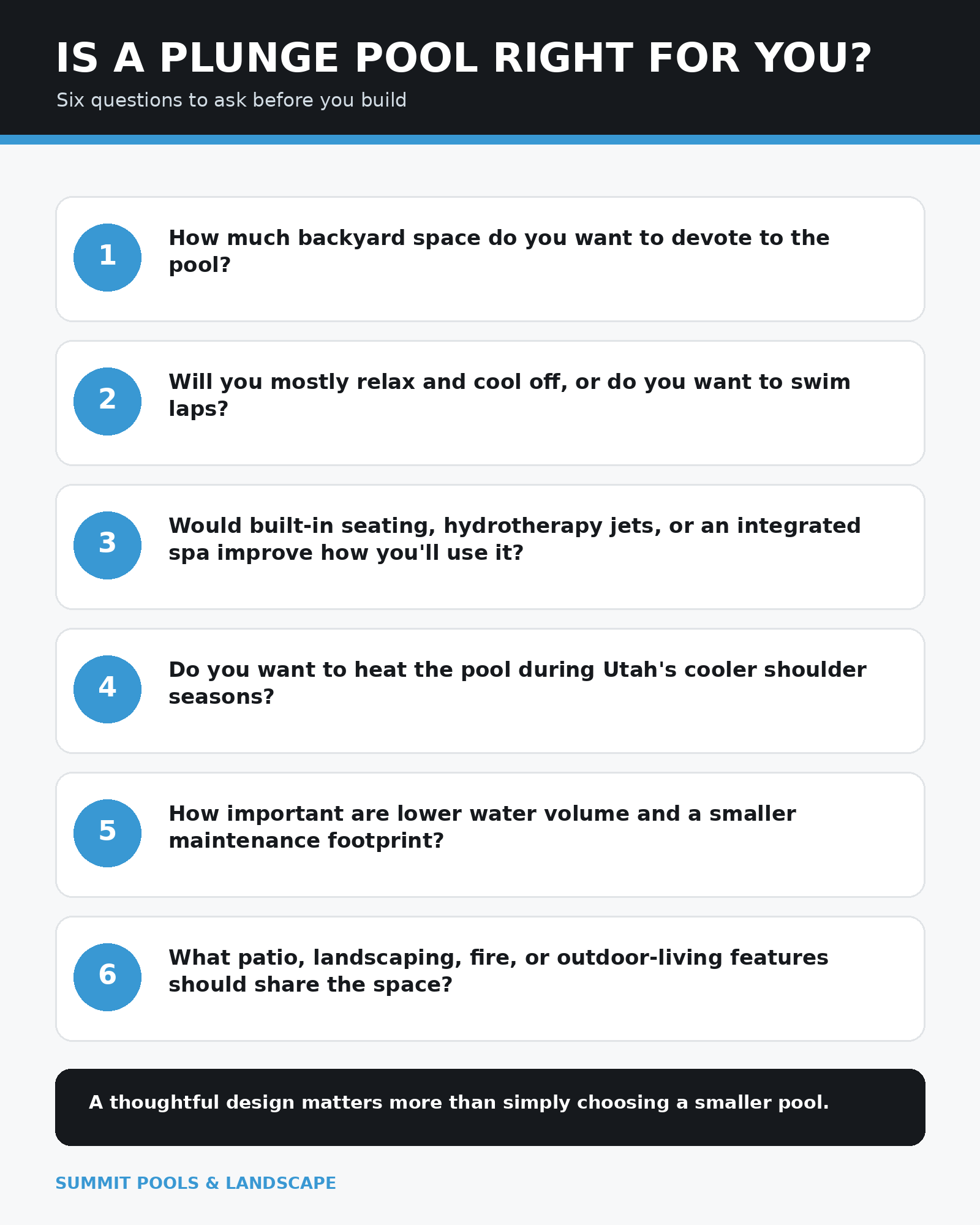
Is a Plunge Pool Right for Your Utah Home?
Before deciding, think about what you want your backyard to look like five years from now.
Do you picture the pool as the centerpiece of the yard?
Or do you picture a complete outdoor living space where the pool is just one part of the experience?
If you'd rather have a smaller body of water surrounded by a beautiful patio, landscaping, outdoor kitchen, fire feature and comfortable seating, a plunge pool could be exactly the right solution.
So, Are Plunge Pools Worth It in Utah?
For homeowners who prioritize relaxation, efficient use of space, outdoor living and a more intimate pool experience, a plunge pool can be an excellent fit for a Utah backyard.
They're particularly compelling when you don't want the swimming pool to consume the entire landscape.
The key is treating it as a custom outdoor-living project, not simply a smaller version of a traditional pool.
At Summit Pools & Landscape, we can design the pool, hardscape and surrounding landscape together so the finished backyard feels intentional from the beginning.
Related Articles
Frequently Asked Questions
-
A plunge pool is a compact swimming pool designed primarily for cooling off, relaxing and socializing rather than lap swimming or large-group recreation. It can include features such as built-in seating, heating, jets and lighting.
-
They can be an excellent option for Utah homeowners, particularly those with smaller yards or homeowners who want to preserve more space for landscaping and outdoor living. Utah's freezing winters mean the pool and equipment still need to be designed and maintained appropriately for the climate.
-
Yes. A plunge pool can be designed with heating, and its smaller water volume can make heating more manageable than a much larger swimming pool. The exact performance and operating cost depend on the pool, equipment, cover, weather and desired temperature.
-
They can cost less than comparable larger pools, but size isn't the only factor affecting price. Excavation, construction type, equipment, site conditions, decking, automatic covers, heating, landscaping and custom features all affect the total project cost.
-
Yes. Hydrotherapy jets and built-in seating can be incorporated into many custom plunge-pool designs, creating a pool that combines aspects of a small swimming pool and a spa.
